
Dzogchen Khenpo Choga Rinpoche’s November 2025 Bhutan pilgrimage, by Sangha Mitra Chuck Jung
Starting on November 4 through November 19, 2025, His Eminence Dzogchen Khenpo Choga Rinpoche led a pilgrimage through Bhutan that unfolded as a continuous engagement with sacred sites, living lineages, and ongoing Buddhist practice. The Bhutan pilgrimage moved through Paro, Thimphu, Bumthang, and Punakha, bringing students into direct contact with places associated with Padmasambhava, Longchen Rabjam, Pema Lingpa, and other central figures of the Nyingma and Dzogchen traditions.
This Bhutan pilgrimage was not presented as a retreat, nor as a historical tour. It was a pilgrimage in the traditional sense: a sequence of visits, practices, teachings, and meetings that unfolded through direct relationship with teachers, monasteries, and the sacred geography of Bhutan. Throughout the journey, Khenpo Choga Rinpoche guided practices, offered teachings, performed rituals, and engaged in formal and informal exchanges with senior Bhutanese lamas and monastic authorities. In this way, the pilgrimage expressed the values of living transmission and ethical continuity that also guide the work of the Dzogchen Shri Singha Foundation.
Arrival in Paro and the establishment of the Bhutan pilgrimage auspicious conditions
On November 4, 2025, the Bhutan pilgrimage arrived in Paro. After landing, they stopped for lunch at a restaurant near the Paro Dzong. Following lunch, the group crossed the footbridge over the river and walked up toward the Paro Dzong, although they did not enter the structure. A dzong is a large fortress-monastery in Bhutan, serving both administrative and religious functions. Dzongs typically contain thick defensive walls, large courtyards, temples, administrative offices, and are often situated on hilltops or other strategic terrain. The Paro Dzong was built between 1644 and 1646 by Zhabdrung Ngawang Namgyal, the figure credited with unifying Bhutan.
That evening, Dzogchen Khenpo Choga Rinpoche led a fire puja. Fire pujas are ritual offerings performed to purify obstacles, harmonize unseen forces, and establish auspicious conditions. Beginning the pilgrimage with a fire puja reflected Rinpoche’s attention to the ritual foundations of Vajrayāna practice and his consistent care for maintaining balance and harmony throughout the journey.
Kyichu Lhakhang and the Early Foundations of Buddhism in Bhutan
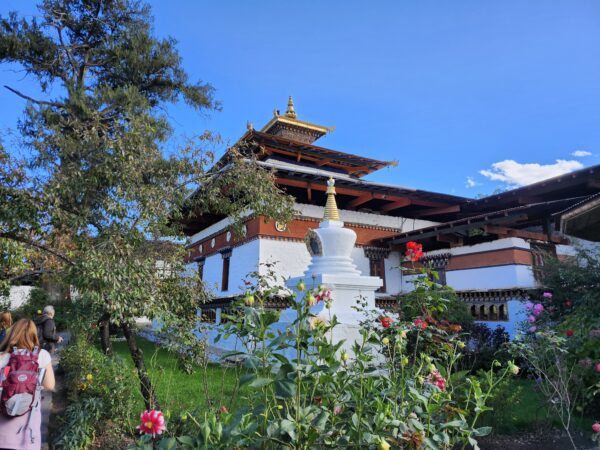
On November 5, the group visited Kyichu Lhakhang Temple in Paro. Kyichu Lhakhang is one of the oldest and most sacred temples in Bhutan, traditionally dated to 659 CE. It was built by the Tibetan Emperor Songtsen Gampo, who ruled Tibet in the early to mid-7th century.
According to Tibetan and Bhutanese Buddhist tradition, Emperor Songtsen Gampo vowed to build a network of 108 temples across Tibet and the Himalayan regions in order to subdue a giant demoness who was obstructing the spread of Buddhism. These temples were constructed at specific points on her body to pin her down and neutralize her negative influence. Kyichu Lhakhang is said to be one of these 108 temples. It is considered one of the two oldest temples in Bhutan, the other being Jampa Lhakhang in Bumthang. Padmasambhava later visited this site in the 8th century, blessing and expanding it.
In the evening, the group drove to the base of the Paro Taktsang cliff, where a small monastery is maintained by a group of monks. The head abbot of this monastery was given the land by the Queen of Bhutan. The monks hosted the group for dinner, after which Dzogchen Khenpo Choga Rinpoche led another fire puja at this location.
Bhutan Pilgrimage Teaching in the Landscape and Encounters with Sacred Objects
On November 6, the group walked up a dirt road from their hotel, stopping along the way for tea at a resort hotel. They continued uphill to a prayer site on the side of the hill. Sitting among prayer flags and overlooking the Paro Valley, Khenpo Choga Rinpoche gave a teaching in this open setting. The teaching took place informally, seated on the hillside, with expansive views of the valley below.
Later that afternoon, the group visited the Paro Museum, which contains a large collection of important Buddhist objects. On the top floor, they viewed a significant Tshogzhing mandala, along with many old and beautiful thangkas and statues. Among the objects seen were a ritual dagger discovered by the tertön Guru Chowang (1212–1270), a piece of iron chain from one of the bridges built by Thangtong Gyalpo (1385–1464), and one of Padmasambhava’s dorjes made from meteoric metal. This dorje is believed to have been crafted under the instruction of Guru Rinpoche by Damchen Dorje Legpa in the 8th century and later discovered as a treasure by Ngadag Nyangrel Nyima Özer (1124–1192).
The group also saw an arrowhead believed to have belonged to Pamo Atalumu, the chief of the soldiers of King Gesar of Ling. She was known as a fierce general and an accomplished archer who used bow and arrows exclusively in battle.
After the museum visit, the group drove into the hills to Samten Ling Monastery, where Longchen Rabjam (Longchenpa) came after leaving Tibet. While staying at this monastery, Longchenpa began writing Resting in Meditation (also known as Resting in Concentration), completing most of the text at this site before finishing it later in Tibet.
Lineage Encounters and Guru Rinpoche’s Practice Sites on the Bhutan Pilgrimage
On November 7, the Bhutan pilgrimage visited a small monastery to meet Lopön Tekchod, the primary disciple of the Fourth Dodrupchen Rinpoche. Khenpo Choga Rinpoche spoke with Lopön Tekchod at length in Tibetan, after which the group received blessings.
Later that day, the group drove south through the Paro Valley and into the mountains to visit a cave where Padmasambhava practiced for several months. During Guru Rinpoche’s time, this cave was located in a charnel ground. A small temple has since been built inside the cave and is maintained by a few monks. The group was allowed to sit and practice inside the temple for several hours. They received blessings from sacred relics (ringsel) of Padmasambhava, including his hand print in stone and a semi-spherical stone associated with magnetizing activity. The surrounding hill is covered with hand prints, footprints, and other imprints attributed to Padmasambhava.
Paro Taktsang: Practice at the Tiger’s Nest
On November 8, the Bhutan pilgrimage hiked to Paro Taktsang, also known as the Tiger’s Nest Monastery. The hike ascends from approximately 2,200 meters at the trail head to about 3,120 meters at the monastery. The group went slowly, and the ascent took several hours. Along the way, they stopped at the site where Palgyi Senge, one of Guru Rinpoche’s 25 disciples, is said to have leapt into the sky, leaving an imprint in the rock.
At the halfway point, the group stopped for lunch at a cafe. While there, they encountered the Oracle who advises the Dalai Lama. The Oracle sat with Khenpo Choga Rinpoche and spoke with him at length. Afterward, the Oracle introduced the group to Ling Rinpoche, the head of the Gelug school, who he was traveling with.
Before entering Paro Taktsang, the group stopped at a viewpoint to confess and purify. Inside the monastery, they were received in a special room and served tea and snacks. They practiced in three rooms: an upper room with a Guru Rinpoche shrine; a room containing the remains of Palgyi Senge, where Dharmapala offerings were made; and the Padmasambhava’s purba shrine room, which contains an image of Dorje Drolo riding on a tiger. A small locked door in this room is said to lead to a shrine containing Guru Rinpoche’s actual purbas.
Thimphu and the Central Monastic Body of Bhutan
On November 9, the Bhutan pilgrimage drove from Paro to Thimphu. Upon arrival, they went directly to the Buddha Dordenma statue overlooking the city. Because they were with Dzogchen Khenpo Choga Rinpoche, they were escorted past large crowds and into meetings with senior monastic authorities. They met with Dorje Lopön, the second-in-command under the Je Khenpo. Rinpoche requested a teaching, and Dorje Lopön gave a brief teaching on the Om Mani Padme Hung mantra, asking the group to recite along with him in Tibetan, and then offered everyone blessings.
Later the group met His Holiness Je Khenpo, the highest religious authority in Bhutan. Khenpo Choga Rinpoche spoke with him in Tibetan and offered him a large dorje, which the Je Khenpo accepted. The group then participated in large public ceremonies involving thousands of monks and practitioners, where it was announced publicly that they were students of Dzogchen Khenpo Choga Rinpoche.
Kalachakra, Global Prayer, and Ongoing Practice
Over the following days, the Bhutan pilgrimage attended the Global Peace Prayer Festival at Changlimithang Stadium, where tens of thousands of people gathered. They participated in ceremonies centered on a large Kalachakra mandala and later received teachings and empowerments from Je Khenpo. During the Kalachakra empowerment, Je Khenpo used the dorje offered earlier by Khenpo Choga Rinpoche, creating a meaningful connection between the pilgrimage group and the broader ceremonial context.
Bumthang, Pema Lingpa, and Longchenpa’s Descendants
On November 14, the Bhutan pilgrimage traveled by bus to Bumthang, a long journey through the mountains. The following day, they visited Mebartsho, the Burning Lake associated with Pema Lingpa’s first treasure discovery in 1476. They practiced on the rock overlooking the pool and took photographs.
Later, they traveled to Shingkhar Lhakhang, built by Longchenpa’s grandson. There, Dzogchen Khenpo Choga Rinpoche performed a ceremony recognizing a young boy as a future lama. The entire village attended. In nearby homes associated with Longchenpa’s family, Rinpoche gave reading transmissions of Longchenpa’s texts and offered practical instructions regarding their care and daily practice.
Tharpaling Monastery
On November 17, the Bhutan pilgrimage visited Tharpaling Monastery, where Longchenpa spent many years practicing, teaching, and writing. They hiked to the retreat cave where Longchenpa practiced for three years, three months, three weeks, and three days. At Tharpaling, they also visited the temple containing the remains of Nyoshül Khenpo Rinpoche. Khenpo Choga Rinpoche, has an auspicious connection with Nyoshül Khenpo Rinpoche, since he assisted in the creation of Nyoshül Khenpo Rinpoche’s book, A Marvelous Garland of Rare Gems, even though he is only created as Dzogchen Khenpo Rinpoche in the book. Khenpo Choga Rinpoche spent time teaching and practicing with the group in this temple that holds Nyoshül Khenpo Rinpoche remains.
Conclusion: Continuity Through Living Practice
This pilgrimage through Bhutan, led by Dzogchen Khenpo Choga Rinpoche, unfolded as an extended expression of living lineage. Through teachings, rituals, meetings, and shared practice, the journey demonstrated how the Dharma continues through direct relationship rather than abstraction. The journey concluded physically in Bhutan, but its purpose continues wherever these practices are carried forward with care, humility, and respect for the Dzogchen lineage.